Cetirizine for Kids: A Parent’s Guide to This Popular Allergy Medicine

Allergy medicine for kids can be tricky. There's so much to choose from on the shelf, and there's advice from well-meaning relatives to "just give them Benadryl! They'll stop sneezing and sleep great!"
Don't listen to that advice, friends. The goal is to treat seasonal allergies in kids WITHOUT turning them into a sleepy zombie or a tiny tornado.
One of the most commonly recommended options is cetirizine, also known as Zyrtec. Cetirizine is one of the most widely used antihistamines in children because it is effective, long-lasting, and usually well-tolerated.
It is commonly used for seasonal and indoor allergies, as well as hives, and has largely replaced older antihistamines like diphenhydramine for routine allergy management in many children.
What Is Cetirizine?
Cetirizine is a second-generation antihistamine that works by blocking histamine, a chemical released by the immune system during allergic reactions.
Histamine release causes many allergy symptoms, including:
- Sneezing
- Runny nose
- Itchy eyes
- Itchy nose
- Hives
- Skin itching
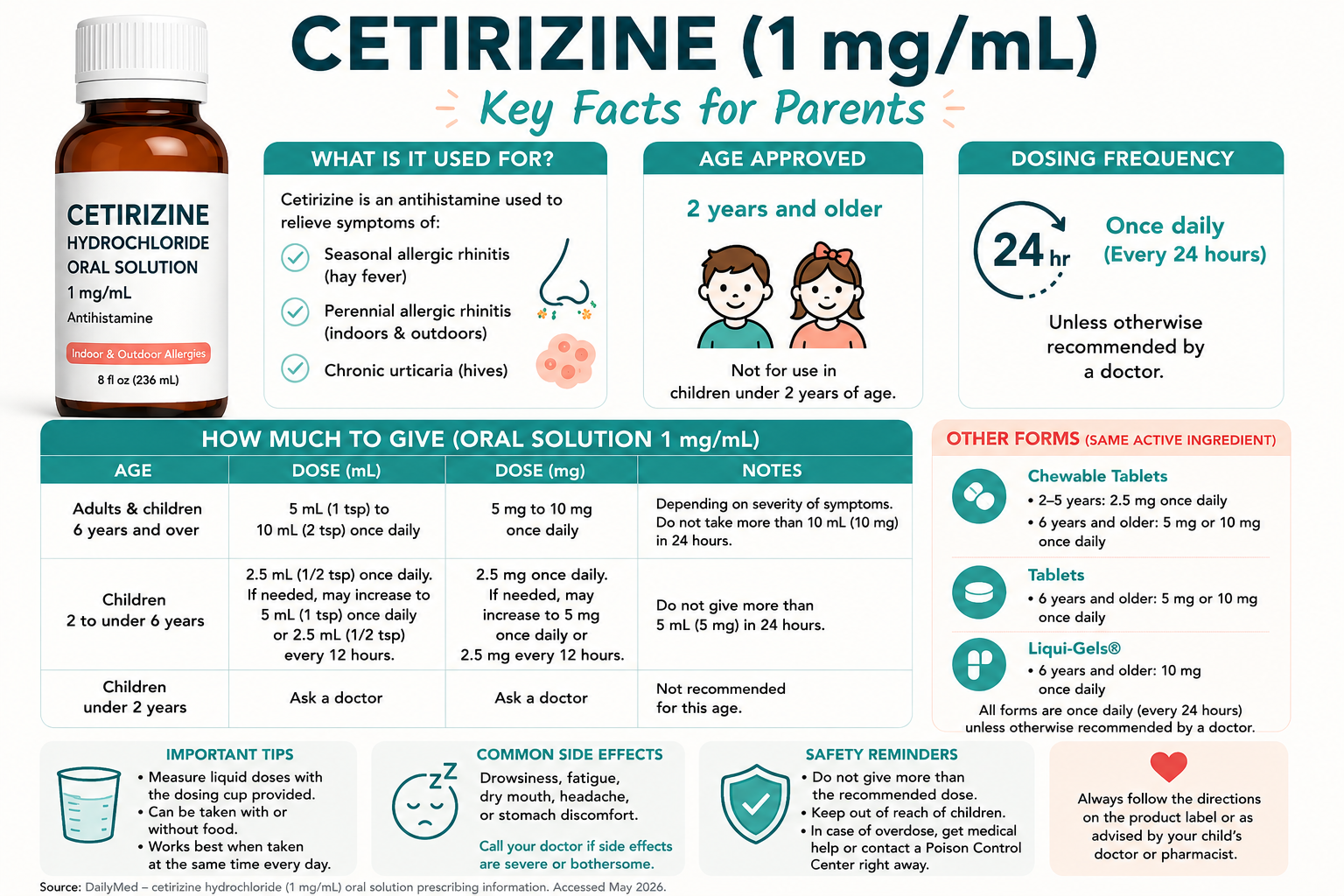
According to FDA-approved labeling, cetirizine is indicated for:
- Seasonal allergic rhinitis
- Perennial allergic rhinitis
- Chronic urticaria (hives)
It is available in several forms (making it an ideal choice for children):
- Liquid syrup
- Chewable tablets
- Tablets
Why Second-Generation Antihistamines Are Preferred
Older antihistamines like Benadryl were once household staples for allergies and itching. While they still have specific uses, professional allergy guidelines now generally recommend second-generation antihistamines like cetirizine for routine allergy treatment.
Second-generation antihistamines like cetirizine:
- last longer
- cause less sedation
- have fewer side effects
- usually only require once daily dosing
The 2020 rhinitis practice parameter update, published in the Journal of Allergy and Clinical Immunology, recommends newer antihistamines over older first-generation antihistamines due to improved safety and tolerability.
International urticaria guidelines similarly recommend second-generation H1 antihistamines as first-line treatment for hives.
That does not mean cetirizine is the only good option. Other second-generation antihistamines (like loratadine or fexofenadine) may also be appropriate, depending on the child and the situation.
There are also other drugs to treat seasonal allergies, as well as non-drug measures parents can follow!
What Cetirizine Helps Treat
In children, cetirizine is commonly used for:
- Seasonal allergies
- Pollen allergies
- Pet allergies
- Dust mite allergies
- Itchy or watery eyes
- Sneezing
- Runny nose
- Hives
- General itching
How Fast Does Cetirizine Work?
Cetirizine starts working relatively quickly compared with some allergy medications. Many kids begin to notice improvement within a few hours, and the medication typically lasts about 24 hours.
However, for good control and symptom relief from seasonal allergens like pollen, it can take a few weeks for cetirizine to reach its peak effect and for allergy symptoms like sneezing to subside. For seasonal allergies, children should ideally start medication before peak allergy season and continue it throughout the season.
Common Side Effects
While it is much better tolerated than diphenhydramine, the most common side effect is drowsiness. Personally, I find that cetirizine works best for my family; however, it's known as one of the more sedating second-generation antihistamines.
If your child becomes too drowsy after a dose of cetirizine, try giving it at bedtime. You can also try switching to another option, such as loratadine (Claritin) or fexofenadine (Allegra).
Besides sleepiness or fatigue, other possible side effects include:
- Dry mouth
- Mild stomach upset
- Headache
- Hyperactivity or irritability
Hyperactivity is a strange one. Just like with Benadryl, some children can experience the opposite effect with cetirizine and become more hyper or irritable instead of sleepy. Although it's less common for this to happen with cetirizine than with older first-generation antihistamines.
Cetirizine for Hives
Cetirizine is also commonly used to treat hives, also known as urticaria. The old advice to give Benadryl for hives - forget it, and try cetirizine instead!
Hives are raised, itchy welts that can appear suddenly and migrate across the body. Viral illnesses, infections, foods, medications, environmental triggers, and allergies can all contribute to hives in children.
Current international urticaria guidelines recommend second-generation antihistamines as first-line treatment for many cases of urticaria because they are effective and generally better tolerated than older sedating antihistamines.
As a side note, significant or severe hives should always be reported to your pediatrician, as should any other severe signs or symptoms of an allergic reaction.
Hives don't always mean an emergency - they can occur for many reasons - but call 911 or seek emergency care for any life-threatening signs of an allergic reaction, such as face or throat swelling, wheezing, or trouble breathing.
Clinical Pearls Parents Should Know
Generic cetirizine works just as well
Store brands contain the same active ingredient as Zyrtec and are usually much less expensive!
Once daily is usually enough
Cetirizine is long-acting. Follow the package label instructions or your pediatrician's advice. Once-daily dosing is typical, and giving additional doses without guidance is not recommended.
“Less drowsy” does not mean “non-drowsy.”
Some children still become sleepy with cetirizine, especially when first starting it.
Allergy medications work best when used consistently
During heavy allergy seasons, daily use is often more effective than waiting until symptoms become severe. Start early in the season and continue throughout.
Antihistamines do not fix everything
Cetirizine works very well for itching, sneezing, and runny nose symptoms, but severe congestion may require additional treatment such as a nasal steroid spray. You may also consider an allergy eye drop for itchy eyes.
When To Talk To Your Pediatrician
You should contact your pediatrician if:
- Symptoms are severe
- Allergy symptoms interfere with sleep or school
- Your child has wheezing or breathing problems (*trouble breathing is an emergency, call 911 or seek urgent/emergent care)
- Hives are associated with swelling or breathing difficulty (*trouble breathing or facial swelling is an emergency, call 911 or seek emergent care)
- Symptoms are not improving with proper treatment
Any hives associated with trouble breathing, lip swelling, tongue swelling, or vomiting should be treated as a medical emergency.
Final Thoughts
Cetirizine is a great choice for treating seasonal allergies in children, as well as other reactions like hives. It's my personal fave for allergy season each spring!
References:
Allergic Rhinitis: Reducing Allergen Exposure in a Changing Environment. (n.d.). Retrieved May 20, 2026, from https://www.aaaai.org/tools-for-the-public/conditions-library/allergies/allergic-rhinitis?utm_source=chatgpt.com
DailyMed—CHILDRENS ZYRTEC ALLERGY- cetirizine hydrochloride syrup. (n.d.). Retrieved May 20, 2026, from https://dailymed.nlm.nih.gov/dailymed/drugInfo.cfm?setid=ee8695ac-1293-4e43-ac7c-a64e21a0ca0a
Dykewicz, M. S., Wallace, D. V., Amrol, D. J., Baroody, F. M., Bernstein, J. A., Craig, T. J., Dinakar, C., Ellis, A. K., Finegold, I., Golden, D. B. K., Greenhawt, M. J., Hagan, J. B., Horner, C. C., Khan, D. A., Lang, D. M., Larenas-Linnemann, D. E. S., Lieberman, J. A., Meltzer, E. O., Oppenheimer, J. J., … Steven, G. C. (2020). Rhinitis 2020: A practice parameter update. Journal of Allergy and Clinical Immunology, 146(4), 721–767. https://doi.org/10.1016/j.jaci.2020.07.007
Zuberbier, T., Abdul Hameed Ansari, Z., Abdul Latiff, A. H., Abuzakouk, M. M., Agcaoili-De Jesus, M. S., Agondi, R. C., Al-Ahmad, M., Alangari, A. A., Alhameli, H., Alonso Bello, C. D., Alshareef, S., Al-Tamemi, S., Altrichter, S., Al Wahshi, H., Aquilina, S., Araújo, M., Arnaout, R., Asero, R., Ballmer-Weber, B., … Giménez-Arnau, A. M. (n.d.). The International Guideline for the Definition, Classification, Diagnosis and Management of Urticaria. Allergy, n/a(n/a). https://doi.org/10.1111/all.70210