If Your Child Gets a Double Dose of Medicine: What Parents Should Do
There are many reasons why children may need medicine. Sometimes it's occasional. Your child has a high fever and refuses to eat or drink. To make them more comfortable and prevent dehydration, giving ibuprofen or acetaminophen is often recommended!
Sometimes they require an occasional antibiotic when kids catch those unavoidable childhood bugs like strep throat. Other children may have a chronic condition that needs daily medication.
While the general advice is that kids should usually have the least amount of medicine for the shortest time needed, it's inevitable that giving medicine to children is part of parenting and will likely happen to every family at some point! During illnesses such as fevers, colds, or allergies, medications may even need to be given multiple times a day.
Unfortunately, dosing errors do happen. In our household, both parents work in the medical field, and it still occurred to us! Two caregivers might give the same medication without realizing it, a dose could be repeated after vomiting, or the timing between doses might be off.
One common dosing mistake is accidentally taking a double dose. An accidental double dose of medicine in children can be frightening for parents. It's happened to me (with cetirizine), and immediate panic sets in!
The main point is that parents should always consult a healthcare professional if a dosing mistake occurs. This includes accidental double doses.
In many cases, the situation might not be dangerous, but a pediatrician, pharmacist, or Poison Control specialist should determine the safest next step. My advice is not to panic, but also don't try to handle it alone!
Why Accidental Double Doses Happen
Medication errors at home are common and can occur in any family. All caregivers make mistakes sometimes.
Situations that may lead to a double dose include:
- Two caregivers giving the same medication unknowingly
- Forgetting when the last dose was given (hello, sleep deprivation!)
- Giving medicine early because it doesn't work or symptoms return
- Repeating a dose after vomiting or spitting out medicine, without realizing that most of the dose was actually absorbed
- Confusing medications that look or sound similar
- Accidentally giving a combination product that contains an ingredient you've already given (like acetaminophen in a cough or cold medicine)
What To Do If Your Child Gets a Double Dose of Medicine
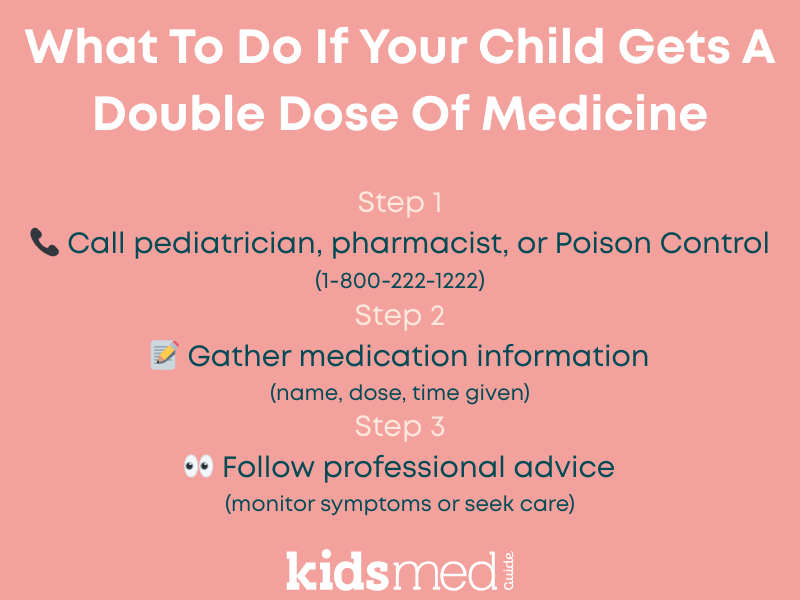
If you believe or suspect your child received an extra dose of medication, the safest course of action is to contact a medical professional for guidance.
You can call:
- Your child’s pediatrician
- A pharmacist
- Poison Control (1-800-222-1222 in the United States)
The advantage of Poison Control specialists is that they are available 24 hours a day, even when the doctor's office or pharmacy may be closed, and they specialize in toxicology (the study of harmful effects of chemicals or substances in the body).
Before calling a medical professional, have the following info handy:
- Name and strength of the medication
- Total amount given
- Time each dose was given
- Your child’s age and weight
- Other medications your child takes or health conditions they have
What to expect after calling Poison Control or your doctor:
When your medical professional has all the information about the double-dose situation, they can give you advice.
Depending on the drug in question and your child, this advice may include:
- Peace of mind if there's nothing to worry about!
- Monitoring at home (they may give you a list of things to watch for)
- Advice to come to the doctor or emergency room for a professional assessment
- Advice to call emergency services
- Next steps: they may tell you to hold the next dose, continue on with regular dosing, etc.
When To Seek Emergency Medical Care
In some situations, parents should avoid wasting time calling a doctor, pharmacist, or poison control and instead seek emergency care immediately.
Call 911 or go to the nearest emergency department if your child develops symptoms such as:
- Trouble breathing
- Severe vomiting
- Seizures
- Extreme sleepiness or difficulty waking
- Confusion or unusual behavior
- Loss of consciousness
These symptoms might signal a serious reaction or overdose and need urgent medical care. If possible, bring the medication with you.
Why Professional Guidance Is Important
Unfortunately, there is no single rule for when your child accidentally takes a double dose of medication. Different medications vary greatly in their safety margins and side effects. The danger of a double dose depends on several factors, including:
- The medication involved
- The amount given
- The time between doses
- The child’s age and weight
- Whether other medicines were also taken
- Your child's individual health history and other medical conditions
Due to these variables, a healthcare professional should always assess the situation before deciding if it's safe to continue monitoring at home and whether your child should receive their next dose as scheduled.
In many cases, healthcare providers may suggest observation, but that decision should be made by a trained medical professional.
Medicines That Often Prompt Parent Questions
Acetaminophen
Acetaminophen is often used for fever and pain. Taking too much can cause liver damage, especially if large doses are repeated. A single double dose might not be a concern, but you should seek medical advice.
Ibuprofen
Ibuprofen is generally safe when used correctly, but it may cause stomach irritation or other symptoms if taken in high doses. Contact your provider for medical advice.
Antihistamines
Medications like diphenhydramine can cause drowsiness, agitation, or other symptoms if taken in large amounts. Contact your doctor, pharmacist, or poison control for guidance.
Prescription Medications
Prescription medications may have different dosing limits and should always be reviewed by a healthcare professional in case of accidental double doses. Call your pediatrician, pharmacy, or poison control center.
How To Prevent Medication Dosing Mistakes
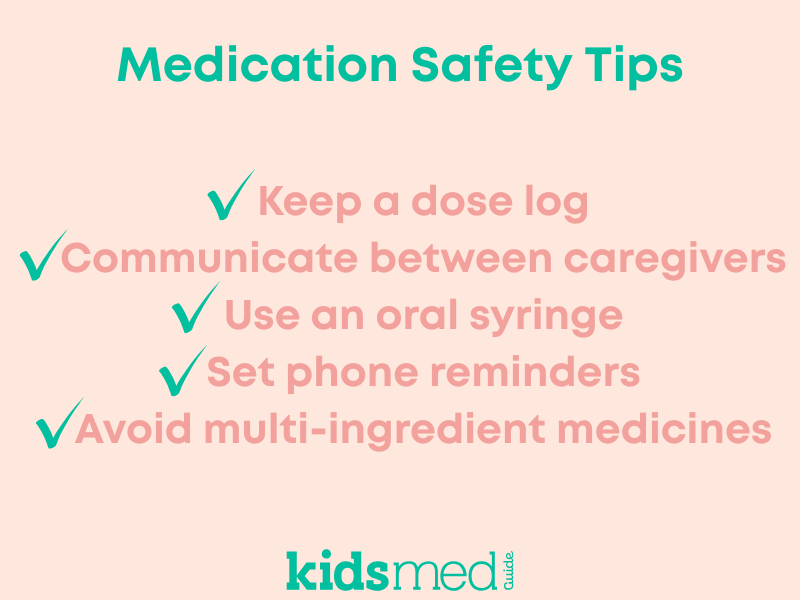
While mistakes can happen to even the best parents, here are some tips to help prevent accidental double doses of medication in your child.
- Don't rely on memory; maintain a written log of all doses. There's a saying in the medical field - if you didn't document it, it didn't happen!
- Make sure all parents and caregivers know about their responsibilities. If multiple adults are giving medicine, communicate that well and use a written log to document each dose.
- Always measure liquid doses with an oral syringe or dosing cup from the pharmacy. Don't use teaspoons or estimate the amounts.
- Keep medicine in its original container.
- Set phone timer reminders for dosing schedules.
- Avoid combination products with multiple ingredients, especially cough-and-cold medicines.
FAQ Section
What should I do if my child accidentally gets a double dose of medicine?
Parents should reach out to their pediatrician, pharmacist, or Poison Control for guidance. A healthcare professional can review what happened and provide advice for the next best steps.
Is a double dose of acetaminophen dangerous for children?
It can be dangerous, especially if repeated doses are given too close together or in large amounts. Because acetaminophen can affect the liver, it is important to contact a healthcare professional for advice if extra doses are taken.
Should I skip the next dose of medicine if my child got two doses?
Sometimes healthcare professionals recommend skipping the next dose, but the correct approach depends on the child, the individual medication, and the amount taken. Parents should check with a pediatrician, pharmacist, or Poison Control before making that decision.
When should I call Poison Control?
Poison Control should be contacted if a child receives more medication than intended, if the medication is unknown, or if parents are unsure about the amount taken. Poison Control is available 24 hours a day at 1-800-222-1222.
What information should I have ready before calling Poison Control?
It is helpful to have the medication bottle and know:
- The medication name and strength
- The dose taken
- The time of ingestion
- The child’s age and weight
- Other medical conditions your child has or other medications they have taken
- Any symptoms the child is experiencing
Are accidental medication errors common in children?
Yes. Medication dosing errors at home are fairly common, which is why many pediatric organizations recommend that parents use dosing tools, medication logs, and seek professional guidance when questions come up.
References:
CDC. (2024, November 18). Medication Safety and Your Health. Medication Safety Program. https://www.cdc.gov/medication-safety/about/index.html
DailyMed—ACETAMINOPHEN liquid. (n.d.). Retrieved March 15, 2026, from https://dailymed.nlm.nih.gov/dailymed/drugInfo.cfm?setid=ace5ebac-ec11-4c26-b1e3-954b450ee671
DailyMed—CHILDRENS IBUPROFEN ORAL SUSPENSION, BUBBLE GUM- ibuprofen suspension. (n.d.). Retrieved March 15, 2026, from https://dailymed.nlm.nih.gov/dailymed/drugInfo.cfm?setid=d27ca801-d4d3-4fd0-a22b-db5ada5fcb9f
DailyMed—DIPHENHYDRAMINE ORAL LIQUID- diphenhydramine hydrochloride liquid. (n.d.). Retrieved March 15, 2026, from https://dailymed.nlm.nih.gov/dailymed/drugInfo.cfm?setid=af5b9c99-03b8-4cf3-80d5-e484b36b6873
Medication Safety. (2025, January 9). HealthyChildren.Org. https://www.healthychildren.org/English/safety-prevention/at-home/medication-safety/Pages/default.aspx
Research, C. for D. E. and. (2025). Got a Sick Kid? Don’t Guess. Read the Label. Make sure you’re giving your children the right medicine and the right amount. FDA. https://www.fda.gov/drugs/safe-use-over-counter-otc-medicines-children/got-sick-kid-dont-guess-read-label-make-sure-youre-giving-your-children-right-medicine-and-right
Vega, I. L., Griswold, M. K., & Laskey, D. (2024). Acute Medication Poisoning. American Family Physician, 109(2), 143–153.