Are Topical Steroid Creams Safe for Kids? A Parent's Guide
Topical steroid creams can safely relieve eczema, bug bites, poison ivy, and other itchy rashes in kids when used correctly.

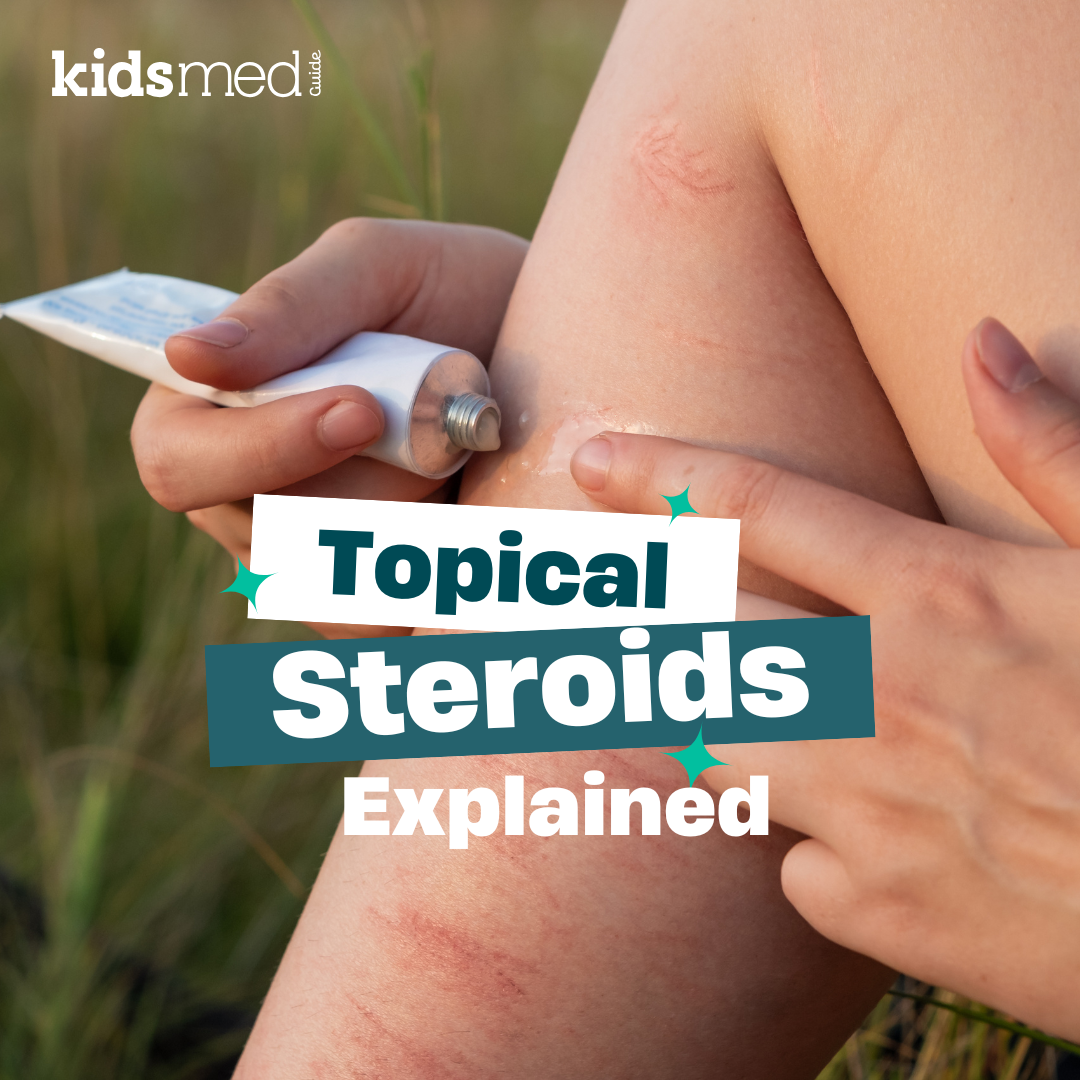
It's summertime, which means kids are outside! Sunshine, playground adventures, and backyard fun 😎 But also - enter bug bites, poison ivy, and itchy rashes.
Topical steroid creams are some of the most commonly recommended medications for itchy, inflamed skin in children. They provide relief for conditions like eczema, poison ivy, insect bites, and allergic skin reactions.
But steroids also have a reputation for causing side effects, leaving many parents nervous to use them or wondering whether they should avoid them altogether. Nobody wants a little roid rage Hulk-child running around.
Fortunately, topical steroids, including over-the-counter hydrocortisone and stronger prescription products, are generally safe when the appropriate medication is used correctly and for the recommended length of time.
What Are Topical Steroids?
Topical corticosteroids, also called steroid creams, reduce inflammation, redness, and itching by working directly at the site of the rash. Because they act mainly on the skin instead of the entire body, they generally cause fewer side effects than oral steroids.
Topical steroids are commonly used to treat:
- Eczema
- Contact dermatitis, including poison ivy and allergic skin reactions
- Insect bites
- Psoriasis in older children
- Certain types of diaper rash under medical supervision
- Itchy inflammatory skin conditions
Types of Topical Steroid Creams
Not all steroid creams are created equal. Some are available over the counter, while others require a prescription.
Healthcare providers generally recommend using the lowest potency steroid that effectively treats the condition. Low potency essentially means that the strength is mild and has fewer side effects.
Mild rashes often respond well to low-potency steroids, while more severe skin conditions may require stronger prescription medications.
Can Hydrocortisone Help? A Quick Guide
| Skin Condition | Hydrocortisone May Help | When to See Your Pediatrician |
|---|---|---|
| Mild eczema | ✅ Yes | If symptoms are not improving after about a week or become severe |
| Bug bites | ✅ Yes | If there are signs of infection, significant swelling, or a severe allergic reaction |
| Mild poison ivy | ✅ Yes | If the rash is widespread, on the face, near the eyes, or very uncomfortable |
| Contact dermatitis | ✅ Often | If the trigger is unknown, the rash is spreading, or symptoms worsen |
| Moderate to severe eczema | ⚠️ Sometimes | Evaluation is usually recommended |
| Severe poison ivy | ❌ Usually not enough | Evaluation is recommended and prescription treatment may be needed |
| Psoriasis | ⚠️ Sometimes | Evaluation is recommended |
This table is a general guide and should not replace medical advice from your child's healthcare provider.
Hydrocortisone: The Most Common Topical Steroid for Kids
Hydrocortisone 0.5% to 1% is among the lowest-potency topical steroids and is available without a prescription. It comes as creams, ointments, lotions, and other formulations.
Hydrocortisone is commonly used for:
- Mild eczema flare-ups
- Insect bites
- Mild poison ivy
- Contact dermatitis
- Itchy skin caused by inflammation
When used correctly, over-the-counter hydrocortisone is generally safe for short-term use in children. Follow the product label, and contact your child’s healthcare provider if the rash has not improved after about seven days.
If your child is an infant or the treatment area involves the face, eyelids, groin, or diaper area, talk with your pediatrician before using hydrocortisone. Infants have thinner skin, allowing more medication to be absorbed, and these sensitive areas are more prone to side effects.
Prescription Topical Steroids
Prescription topical steroids include products containing medications such as triamcinolone, mometasone, and betamethasone.
Their potency can vary depending on the medication, concentration, and whether the product is a cream, ointment, lotion, or another formulation.
These medications are often used for:
- Moderate or severe eczema
- Significant poison ivy reactions
- Psoriasis
- Other inflammatory skin conditions that have not improved with hydrocortisone
Prescription topical steroids are very effective when used appropriately, but because they are stronger, they should always be used exactly as directed by your child's healthcare provider.
If a large portion of the body requires treatment or long-term steroid use is anticipated, your healthcare provider may recommend another medication instead.
Cream, Ointment, or Lotion: Which Is Best?
Ever stood in the pharmacy aisle and looked at 14 types of topical hydrocortisone products while your eyes slowly glaze over? Me too.
Dosage Forms of Topical Steroids:
- Creams are the most commonly used and work well for most rashes.
- Ointments are thicker, contain more oil, and tend to work better for very dry eczema because they help lock in moisture.
- Lotions spread easily over large or hairy areas, such as the scalp.
Your healthcare provider may recommend one formulation over another depending on your child's skin condition.
Related: Reading Medication Labels
How to Use Topical Steroids Safely
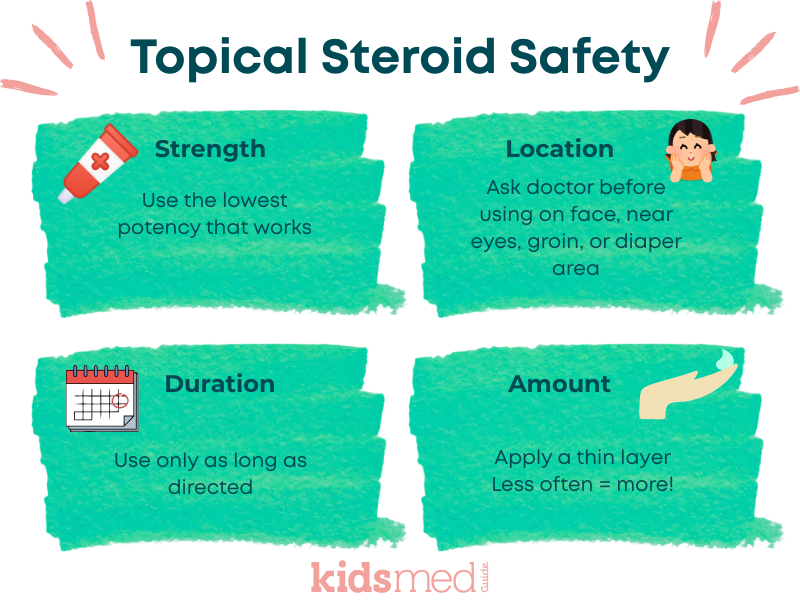
- Apply a thin layer only to the affected skin.
- Gently smooth it over the rash instead of applying it like a moisturizer.
- Most products are used one or two times each day.
- Use the medication only for the duration recommended by your healthcare provider.
- Avoid broken skin or open wounds unless instructed otherwise.
- Do not use on the face, eyelids, groin, or diaper area without medical guidance.
- Wash your hands before and after applying the medication.
- Store medications safely out of reach of children and pets.
Pro Tip: The Fingertip Unit
One fingertip length of cream, measured from the tip of an adult finger to the first crease, is usually the correct amount of medication to cover about two adult handprints of skin.
Keep that in mind when estimating how much cream to apply to your child! It's easy to use too much. Using more cream does not make the medication work faster. Applying a thin layer is usually all that's needed.
Can You Use Moisturizer With Steroid Cream?
Yup! For children with eczema, moisturizers are one of the most important parts of treatment.
Apply the topical steroid only to the inflamed areas as directed. Moisturizer can then be applied generously to the surrounding skin and other dry areas. You do not need to turn this into a complicated 14-step skin care ceremony, but follow your child’s treatment plan if the pediatrician or dermatologist recommends a specific order.
Even after the steroid is stopped, continuing a daily moisturizer can help reduce future eczema flare-ups.
When to Check Before Using a Topical Steroid
- You suspect the rash may be caused by a bacterial, fungal, or viral infection unless a healthcare provider has recommended the steroid as part of the treatment plan.
- The diagnosis is unclear. See a pediatrician if you don't know what's going on.
- The area is an open wound, ulcer, or severely damaged skin unless directed by a healthcare provider.
- The rash is rapidly worsening despite treatment.
If you're unsure what's causing your child's rash, it's best to have it evaluated before starting treatment!
Side Effects to Watch For
Topical steroids are generally well tolerated, especially when low-potency products such as over-the-counter hydrocortisone cream are used for short periods.
Possible side effects include:
- Thinning of the skin, especially with prolonged use
- Stretch marks
- Skin discoloration
- Easy bruising
- Acne-like breakouts
- Increased risk of skin infection
Rarely, using strong steroids over large areas for prolonged periods can allow enough medication to be absorbed into the body to cause hormonal effects, particularly in infants and young children.
These complications are uncommon when low-potency steroids, such as hydrocortisone, are used appropriately.
When to Call Your Pediatrician
Contact your child's healthcare provider if:
- The rash covers a large area.
- The rash involves the face, eyes, or genitals.
- The rash is becoming more painful or appears infected.
- Your child develops a fever along with the rash, or you suspect an infection
- The rash is not improving after about one week of treatment.
- You are unsure what is causing the rash.
Frequently Asked Questions
Can I Use Hydrocortisone Cream on My Child's Face?
Hydrocortisone should generally not be applied to the face unless your child's healthcare provider recommends it. Facial skin is thinner and absorbs medication more readily, increasing the risk of side effects.
How Long Can My Child Use Hydrocortisone Cream?
Most over-the-counter hydrocortisone products should be used for no more than 7 days unless your child's healthcare provider recommends otherwise. If the rash does not improve, your child should be re-evaluated.
Can I Use Hydrocortisone for Bug Bites?
Yes. Hydrocortisone is commonly used to reduce itching and inflammation from insect bites and other mild inflammatory skin reactions.
Does Hydrocortisone Help Poison Ivy?
Yes. Mild poison ivy rashes often improve with over-the-counter hydrocortisone cream. More severe cases may require a prescription-strength topical steroid or oral steroids. If you're dealing with poison ivy, be sure to check out our complete guide to treating it in kids.
What Is the Difference Between Hydrocortisone and Prescription Steroid Creams?
Hydrocortisone is a low-potency steroid available over the counter. Prescription topical steroids are stronger medications used for more severe inflammatory skin conditions and are used under medical supervision.
Parents Also Ask:
 KidsMedMom Andrea M., PharmD, BCPPS
 KidsMedMom Andrea M., PharmD, BCPPS
 KidsMedMom Andrea M., PharmD, BCPPS
References
Axon, E., Chalmers, J. R., Santer, M., Ridd, M. J., Lawton, S., Langan, S. M., Grindlay, D. J. C., Muller, I., Roberts, A., Ahmed, A., Williams, H. C., & Thomas, K. S. (2021). Safety of topical corticosteroids in atopic eczema: An umbrella review. BMJ Open, 11(7), e046476. https://doi.org/10.1136/bmjopen-2020-046476
Corticosteroids for Atopic Dermatitis. (n.d.). Retrieved July 16, 2026, from https://www.aap.org/en/patient-care/atopic-dermatitis/treatment-of-atopic-dermatitis/corticosteroids-for-atopic-dermatitis/
How to Treat & Control Eczema (Atopic Dermatitis) Rashes in Children. (2025, May 14). HealthyChildren.Org. https://www.healthychildren.org/English/health-issues/conditions/skin/Pages/how-to-treat-and-control-eczema-rashes-in-children.aspx
Poison Ivy, Poison Oak & Poison Sumac Rash: How to Avoid or Treat It. (2025, June 27). HealthyChildren.Org. https://www.healthychildren.org/English/health-issues/conditions/skin/Pages/Poison-Ivy-Treatment.aspx
Schoch, J. J., Anderson, K. R., Jones, A. E., Tollefson, M. M., & Section on Dermatology. (2025). Atopic Dermatitis: Update on Skin-Directed Management: Clinical Report. Pediatrics, 155(6), e2025071812. https://doi.org/10.1542/peds.2025-071812
Stacey, S. K., & McEleney, M. (2021). Topical Corticosteroids: Choice and Application. American Family Physician, 103(6), 337–343.