Best Allergy Medications for Kids: A Parent’s Guide to What Works

If it seems like your child is constantly sneezing, sniffling, or rubbing their eyes whenever the seasons change, you might be dealing with seasonal allergies.
Spring allergy season is here! Warmer climates have already seen a pollen burst, and we frozen Eskimos up in the Northern part of the country are watching snow melt just in time to see fresh green poking through.
That means that winter colds are dying down, but thanks to the proliferation of pollen each spring, runny noses are still ramping up.
One of the most common questions I get from friends and patients' families is:
What is the best allergy medication for kids?
The answer depends on your child’s symptoms. But the good news is we have several safe, effective options. The key is to select the right one for the situation and stick with it throughout the allergy season!
Understanding Allergy Symptoms in Children
Before choosing the best allergy medicine for kids, it helps to confirm that allergies are actually the cause.
Common symptoms include:
- Sneezing
- Runny or clear nasal discharge
- Itchy, watery eyes
- Nasal congestion
- Throat itching
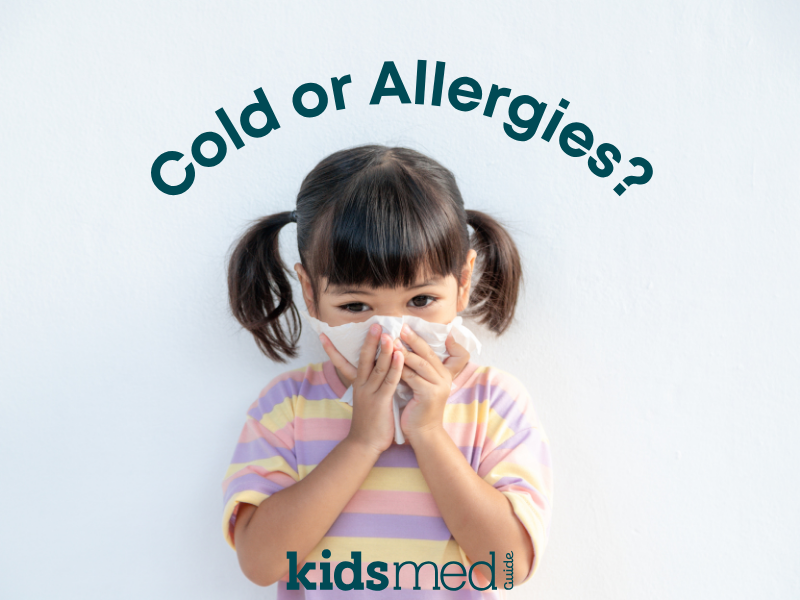
Unlike a cold, allergies:
- Do not cause fever
- Last for weeks or longer
- Often follow a seasonal pattern
Want more tips on allergies vs. a cold? Read our ultimate allergy blog: Seasonal Allergies in Kids!
Types of Allergy Medications for Kids
When it comes to allergy medication for children, there are several main categories. Each works differently, and many children benefit from using a combination.
Antihistamines for Kids: First-Line Allergy Relief
Oral (by mouth) antihistamines are usually the first choice for kids' allergy medicines. They block histamine, which causes many allergy symptoms.
Second-generation antihistamines include cetirizine (Zyrtec), loratadine (Claritin), and fexofenadine (Allegra). Second-generation antihistamines are much preferred over older drugs and have a safer side effect profile.
Some oral antihistamines can be used in children as young as 2 years of age for seasonal allergies, although you should always read the product label to confirm.
Common options:
- Cetirizine (Zyrtec)
- Loratadine (Claritin)
- Fexofenadine (Allegra)
Why these often are the best allergy medicines for kids:
- Once or twice daily dosing (always read the label)
- Minimal drowsiness
- Effective for sneezing, runny nose, and itching
- Well tolerated (kids aren't likely to refuse them)
- Come in a variety of flavors and dosage forms
Clinical pearl:
Cetirizine is often slightly more effective, but may cause mild drowsiness. Loratadine is less sedating but sometimes a bit less potent.
What about Benadryl?
Diphenhydramine (Benadryl) is effective but not suitable for daily use due to its sedating effects and short duration of action. It has fallen out of favor in recent years due to its side-effect profile. It is no longer the preferred choice in children.
If you've never heard of a "paradoxical reaction," you're lucky! A paradoxical reaction is when a drug has the opposite effect of what you would expect - and in kids, Benadryl can sometimes make them hyper and crazy! No thanks.
Nasal Steroids: The Most Effective Allergy Medicine for Congestion
For children experiencing lots of nasal congestion, nasal steroid sprays are often considered the most effective allergy medication for kids overall.
Nasal steroids are considered a good first-line treatment for seasonal allergies, but parents sometimes opt for an oral antihistamine first because it may be easier to administer, depending on their child's disposition and tolerance to nasal spray.
Common options:
- Fluticasone (Flonase)
- Triamcinolone (Nasacort)
Why they work so well:
- Reduce inflammation directly in the nose - hit it right at the source!
- Improve congestion, sneezing, and a runny nose
- Works best when used consistently
- Minimal systemic side effects, including less risk of drowsiness
Parent tip:
These are not instant. They can take several days to start working, with full effect in about 1–2 weeks.
Intranasal steroids are effective for allergies and inflammation, but some children can't tolerate nasal spray, so it's not always an option. If your child puts up a big fight, it's likely not worth the stress!
Allergy Eye Drops for Kids
If itchy, watery eyes are the main issue, targeted treatment helps. Allergy eye drops are safe for kids (check the label; some products are safe for ages 2-3 and up!).
Option:
- Ketotifen (Zaditor, Alaway)
These offer quick relief and are a helpful supplement to oral allergy medications or nasal sprays.
If itchy eyes are the only symptom, you might consider treating with allergy eye drops only. However, children often need additional treatment, such as an oral antihistamine and/or a nasal spray, in addition to the allergy eye drops.
Which Allergy Medication Is Best for Kids? (Quick Comparison)
Here’s a simple way to think about it:
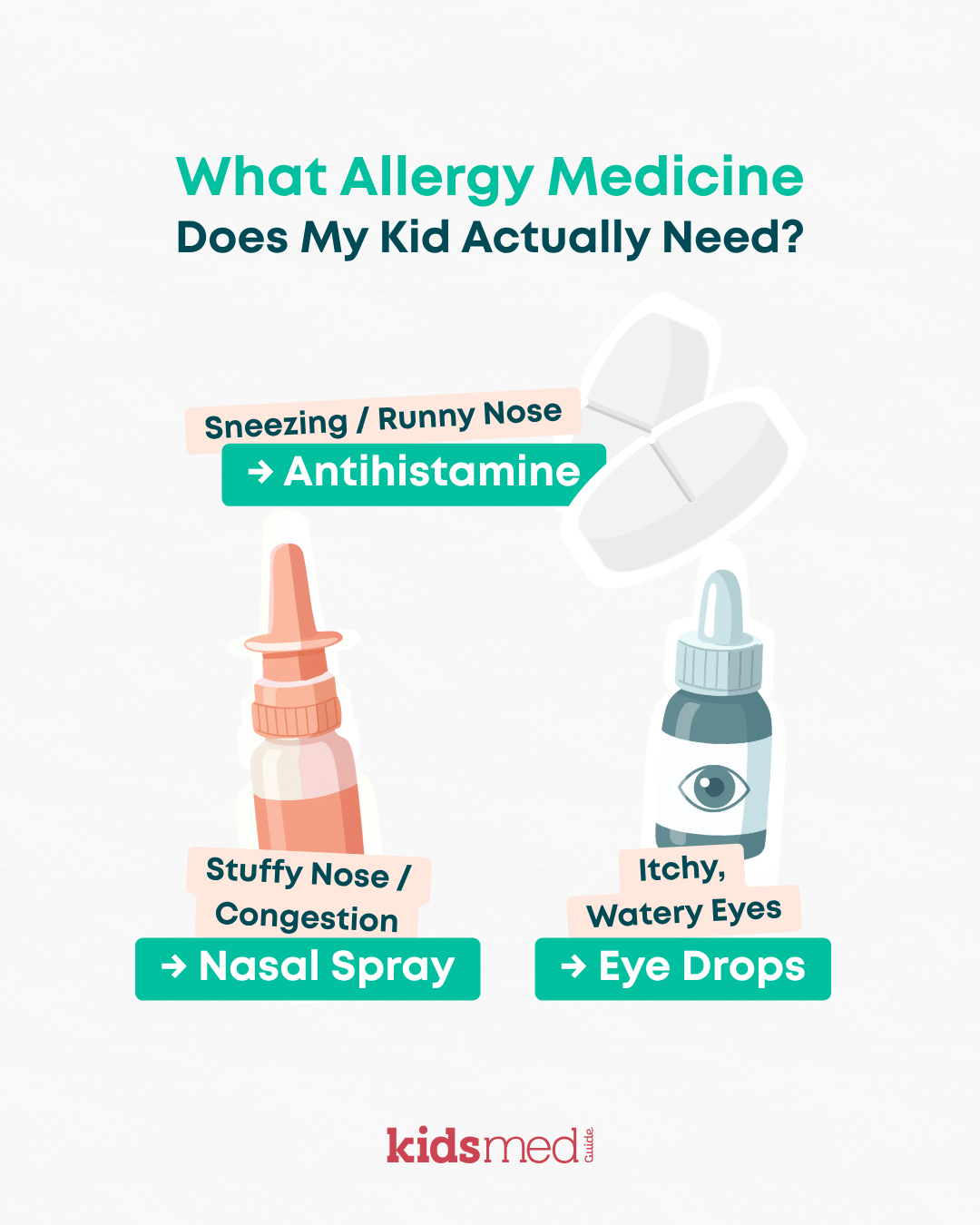
- Sneezing, runny nose → oral antihistamine
- Stuffy nose → nasal steroid
- Itchy eyes → eye drops
Many children need a combination, especially during peak allergy seasons.
When to Start Allergy Medicine for Kids
Timing can make a big difference. Starting early with seasonal allergy medicine for kids can help prevent symptoms from becoming severe. If your child gets allergic rhinitis every year starting in mid-April, go ahead and get antihistamines to start at the beginning of the month!
- Spring allergies → start early spring
- Fall allergies → start late summer
This varies by geographic location, but the best advice is to start your daily maintenance therapy (either a steroid nasal spray or an oral antihistamine) a couple of weeks before pollen counts start to increase.
Safety Tips for Using Allergy Medications in Children
- Use age-appropriate products and dosing
- Always measure liquids with an oral syringe
- Avoid doubling up on antihistamines
- Check labels for duplicate ingredients
When to Talk to Your Pediatrician
- Symptoms are not improving with medication
- Your child has wheezing or breathing issues
- Your child has asthma that is worsened by allergies and needs an adjustment to their asthma action plan
- Allergies are affecting sleep or school
- You are unsure which medication to choose
- Your child has a fever, body aches, or other symptoms that suggest it's more likely an illness or infection
The Bottom Line
The best allergy medications for kids depend on the symptoms you're aiming to treat!
- Antihistamines are a great starting point, taken orally, well tolerated, and good at helping with all symptoms
- Nasal steroids are the most effective for nasal congestion and are also considered a first-line treatment for seasonal allergies
- Eye drops help target itchy eyes and can be added on to other treatments or used alone (if eye itchiness is the only symptom)
Non-drug treatments are also important! Managing your child's environment can help control and reduce their symptoms. Visit our blog on treating and preventing seasonal allergies without medication for more info!
Until next time, folks. Keep those tissues handy.
FAQs
What is the best allergy medicine for kids?
Second-generation oral antihistamines like cetirizine (Zyrtec) and loratadine (Claritin) are commonly used and well-tolerated. Nasal steroids are often the most effective for congestion.
Can kids take allergy medicine every day?
Yes. Second-generation oral antihistamines like Zyrtec (cetirizine) and Claritin (loratadine) are taken every day, and work best when given throughout the allergy season.
What is better for kids, Zyrtec or Claritin?
Both are effective. Zyrtec (cetirizine) may work slightly better, but it can cause more drowsiness than Claritin (loratadine). If your child doesn't get optimal relief or doesn't tolerate one antihistamine, try the other. Allegra (fexofenadine) is another option.
Are nasal sprays safe for children?
Yes, when used as directed, nasal steroid sprays are safe and effective. Follow the product label for age recommendations and dose instructions.
How long do allergy medications take to work?
Antihistamines work within hours. Nasal steroids may take several days to reach full effect. Both treatments work best when taken consistently throughout the allergy season.
References:
Allergies & Asthma. (2015, November 21). HealthyChildren.Org. https://www.healthychildren.org/English/health-issues/conditions/allergies-asthma/Pages/default.aspx
Brożek, J. L., Bousquet, J., Agache, I., Agarwal, A., Bachert, C., Bosnic-Anticevich, S., Brignardello-Petersen, R., Canonica, G. W., Casale, T., Chavannes, N. H., Correia de Sousa, J., Cruz, A. A., Cuello-Garcia, C. A., Demoly, P., Dykewicz, M., Etxeandia-Ikobaltzeta, I., Florez, I. D., Fokkens, W., Fonseca, J., … Schünemann, H. J. (2017). Allergic Rhinitis and its Impact on Asthma (ARIA) guidelines-2016 revision. The Journal of Allergy and Clinical Immunology, 140(4), 950–958. https://doi.org/10.1016/j.jaci.2017.03.050
DailyMed—ALLEROFF- cetirizine hydrochloride syrup. (n.d.). Retrieved March 31, 2026, from https://dailymed.nlm.nih.gov/dailymed/drugInfo.cfm?setid=b82fbeb9-021a-484b-9896-5a5b945c5827
DailyMed—BEST CHOICE CHILDRENS LORATADINE- loratadine solution. (n.d.). Retrieved March 31, 2026, from https://dailymed.nlm.nih.gov/dailymed/drugInfo.cfm?setid=94252815-03d7-4de0-81f9-ff508dbc4453
DailyMed—CHILDRENS FEXOFENADINE HYDROCHLORIDE ALLERGY- fexofenadine hydrochloride suspension. (n.d.). Retrieved March 31, 2026, from https://dailymed.nlm.nih.gov/dailymed/drugInfo.cfm?setid=b21bb11d-bf74-4ee7-9cfe-5b599a3c4775
DailyMed—CHILDRENS FLUTICASONE PROPIONATE- fluticasone propionate spray, metered. (n.d.). Retrieved March 31, 2026, from https://dailymed.nlm.nih.gov/dailymed/drugInfo.cfm?setid=180ef101-dca6-496f-8376-63449d82d083
DailyMed—TRIAMCINOLONE ACETONIDE NASAL- triamcinolone acetonide spray, metered. (n.d.). Retrieved March 31, 2026, from https://dailymed.nlm.nih.gov/dailymed/drugInfo.cfm?setid=8468115a-4f0c-4ae8-bcd6-38f8b81cf871
Ketotifen Drops. (n.d.). Retrieved March 31, 2026, from https://dailymed.nlm.nih.gov/dailymed/drugInfo.cfm?setid=b1ea15a5-5354-4086-a22d-cc1b3e0e1eb3
Dykewicz, M. S., Wallace, D. V., Amrol, D. J., Baroody, F. M., Bernstein, J. A., Craig, T. J., Dinakar, C., Ellis, A. K., Finegold, I., Golden, D. B. K., Greenhawt, M. J., Hagan, J. B., Horner, C. C., Khan, D. A., Lang, D. M., Larenas-Linnemann, D. E. S., Lieberman, J. A., Meltzer, E. O., Oppenheimer, J. J., … Steven, G. C. (2020). Rhinitis 2020: A practice parameter update. Journal of Allergy and Clinical Immunology, 146(4), 721–767. https://doi.org/10.1016/j.jaci.2020.07.007
Hay Fever (Rhinitis) | Symptoms & Treatment | ACAAI Public Website. (n.d.). ACAAI Patient. Retrieved March 31, 2026, from https://acaai.org/allergies/allergic-conditions/hay-fever/
Seidman, M. D., Gurgel, R. K., Lin, S. Y., Schwartz, S. R., Baroody, F. M., Bonner, J. R., Dawson, D. E., Dykewicz, M. S., Hackell, J. M., Han, J. K., Ishman, S. L., Krouse, H. J., Malekzadeh, S., Mims, J. W. W., Omole, F. S., Reddy, W. D., Wallace, D. V., Walsh, S. A., Warren, B. E., … Guideline Otolaryngology Development Group. AAO-HNSF. (2015). Clinical practice guideline: Allergic rhinitis. Otolaryngology--Head and Neck Surgery: Official Journal of American Academy of Otolaryngology-Head and Neck Surgery, 152(1 Suppl), S1-43. https://doi.org/10.1177/0194599814561600