
Safe Use of Humidifiers and Vapor Rubs in Children

Cold season has a special talent for humbling parents. One minute, you are confident and well rested. The next, you are standing in your kitchen at 2 a.m. holding a humidifier manual, trying to understand the English language with only one eye open.
As a parent, I will fully admit that I have probably purchased 10 humidifiers over the years. Not because they break, but because I forget to clean them properly, feel personally attacked by the mineral buildup inside, and decide it is emotionally healthier to buy a new one.
This article focuses on the safe use of humidifiers and vapor rubs in children, emphasizing what helps, what poses risks, and what pediatric organizations recommend.
Baby snot, unfortunately, remains undefeated.
Understanding the Role of Humidifiers and Vapor Rubs
Humidifiers and vapor rubs (like Vicks VaporRub®) do not treat the virus that causes a cold. Time, rest, and fluids are the only road to recovery.
Humidifiers add moisture to dry indoor air, which may help thin nasal secretions, soothe irritated airways, and make breathing more comfortable. This can be helpful at night, when congestion often worsens and much-needed sleep becomes harder to come by. Humidifiers are less effective than saline applied directly to the nose.
Vapor rubs work through smell and sensation. Ingredients such as menthol and eucalyptus create a cooling sensation that can help children breathe more easily by making it feel more comfortable.
It’s a bit of a brain trick because vapor rubs don’t actually affect breathing at all, but for some children, they may provide symptom relief. This is a comfort effect rather than an actual change in airflow.
Safe Use of Humidifiers for Children
Many parents are concerned about the safe use of humidifiers!
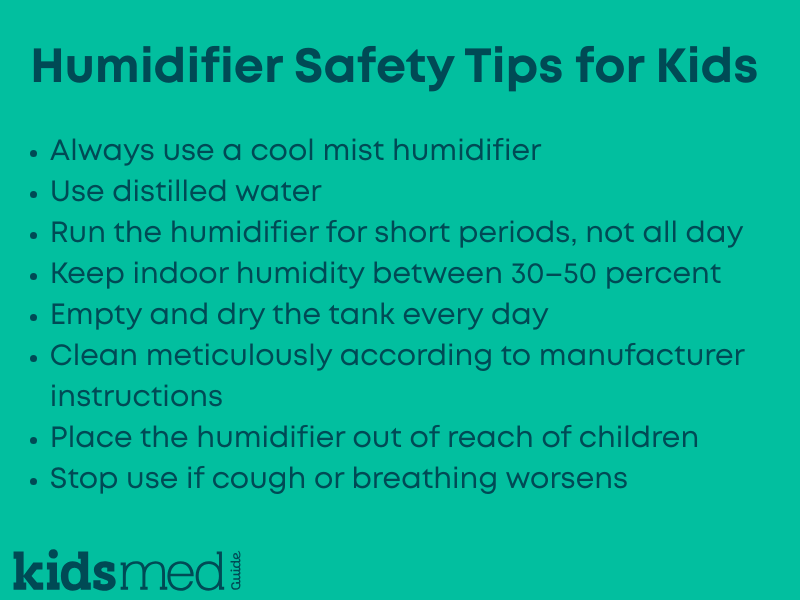
Cool mist humidifiers are the safest option for children. Warm mist and steam humidifiers increase the risk of burns, especially in homes with young children.
Toddlers will knock over a humidifier 10 out of 10 times if given the opportunity.
When filling your cool-mist humidifier, use distilled water. Tap water contains minerals that can be released into the air as fine particles, and there is also a potential for microbes. These particles can irritate the lungs, particularly in infants and children with asthma or reactive airways. Distilled water significantly reduces this risk.
Humidifiers should be used for short periods, not continuously. The ideal indoor humidity is generally between 30 and 50 percent. Higher humidity levels can promote mold growth and dust mites, which may worsen cough, congestion, or asthma symptoms.
Cleaning is super important! Humidifiers should be emptied daily, thoroughly dried, and carefully cleaned according to the manufacturer’s instructions. Do this regularly throughout the illness while your humidifier is in use.
Poorly maintained humidifiers can release mold and bacteria into the air, potentially worsening respiratory symptoms rather than helping them. This is one reason pediatric organizations caution families against using humidifiers if regular cleaning cannot be performed.
Place humidifiers on a stable surface, out of reach of children, and away from bedding or direct airflow toward the face.
To be honest, I have used humidifiers in the past, but I find the cleaning and drying to be more trouble than it’s worth!
For me, there isn’t a huge benefit to a humidifier that justifies the extra cleaning work when I’m already drowning in laundry and tissues. I prefer letting my child sit in a warm, steamy bathroom or using nasal saline.
Proper Way to Use Vapor Rubs in Children
The proper way to use vapor rubs in children requires careful attention to age and application.
Most vapor rub products are labeled for children 2 years of age and older. They should never be used on infants and toddlers under age 2 unless specifically advised by a pediatrician. Infants have very small airways, and strong vapors can worsen breathing.
Vapor rubs are for topical use only! Read and follow the directions carefully.
Vapor rubs should never be applied under the nose, inside the nostrils, to broken skin, or anywhere they could be licked or ingested. Camphor-containing products can be dangerous if swallowed, even in small amounts.
Apply only a small amount to the chest or upper back, following the product label exactly. Thoroughly wash hands after application to prevent accidental exposure to the eyes or mouth.
Children with asthma or sensitive airways should be closely monitored. Talk with your pediatrician before use, and if you try a vapor rub, watch your child closely. Vapor rubs can irritate the airways in some children and trigger coughing or wheezing. If symptoms worsen, stop using the product and seek care as needed.
Choosing the Right Humidifier and Vapor Rub Products
When choosing a humidifier for children, select a cool-mist option within your budget that prioritizes simplicity and ease of cleaning. Devices with fewer parts are more likely to be appropriately cleaned.
Avoid adding essential oils, medications, or additives to humidifiers – use distilled water only. Essential oils are generally not recommended for children to breathe in. They are unregulated and can cause lung sensitivity.
If your child needs inhaled medications, they should be prescribed by your doctor and delivered via a medical-grade nebulizer.
For vapor rubs, read labels carefully and choose products designed for children, not adult formulations. Do not use on children under age 2, and do not use on or near the mouth or nose.
Common Mistakes Parents Should Avoid
Common mistakes include running humidifiers nonstop, neglecting regular cleaning, and using tap water instead of distilled water. Any of these can increase the risk of respiratory irritation or infection.
Another frequent issue is overusing or misapplying vapor rubs. Using more product does not provide more relief and increases the risk of side effects. Children have thinner, more sensitive skin than adults and are more susceptible to side effects from overapplying topical products.
Parents should also avoid relying on vapor rubs as the primary treatment for colds. They do not shorten the duration of illness or treat the underlying infection.
What actually helps most with colds:
While boring and not fancy, the best advice is to:
- Use nasal saline drops or spray with gentle suction as needed.
- Adequate fluids. Water, electrolyte drinks, soup, popsicles, and broth... anything your child will drink!
- Rest, rest, rest!
- Comfort measures such as upright positioning and careful use of humidified air (consider a warm bath or sitting in the bathroom with the shower running for 5-minute intervals several times per day). Abide by safe sleep guidelines if your child is an infant.
Some research suggests that using hypertonic (extra-strength) saline in the nose helps shorten the duration of children’s colds and helps prevent other family members from getting sick.
Read More!: Our KMG guide to Sick Day Essentials
When to See a Pediatrician
Parents should contact a pediatrician if a child has difficulty breathing, rapid breathing, chest retractions, persistent fever, fever in an infant under 3 months or in an immunocompromised child, poor feeding, or worsening symptoms rather than improvement.
Children with asthma or other underlying respiratory conditions should check with a healthcare provider before using humidifiers or vapor rubs.
Conclusion
The safe use of humidifiers and vapor rubs in children includes selecting a cool-mist model to prevent burns, using distilled water, limiting run time, cleaning thoroughly, and using vapor rubs only in children over age 2, per the package instructions.
And even when everything is done perfectly, baby snot will still happen. Some things are simply part of childhood.
FAQ Section
What type of humidifier is safest for children
Cool-mist humidifiers are safest because they reduce the risk of burns and provide adequate moisture when used correctly. Select a model that is easy to clean to reduce the risk of irritation and infection.
Can vapor rubs be used for babies
No. Most vapor rubs are labeled for children aged 2 years and older and should never be used on infants unless directed by a pediatrician.
How often should a humidifier be cleaned
Humidifiers should be emptied daily, dried completely, and cleaned meticulously according to manufacturer instructions.
Are essential oils safe to use in humidifiers for kids
In general, no. Many essential oils can irritate the airways and are not intended for inhalation by children. Essential oils are not regulated.
When should I contact a doctor about my child’s cough or congestion
Contact a pediatrician if breathing becomes difficult, fever persists, symptoms worsen, or your child has underlying respiratory conditions.
The following references were used to compile this information:
Cough & Cold Survival Kit: Symptom-Relief Essentials for Families. (2024, December 10). HealthyChildren.Org. https://www.healthychildren.org/English/health-issues/conditions/chest-lungs/Pages/cough-and-cold-survival-kit-top-symptom-relief-essentials-for-families.aspx?_gl=1*cy9oht*_ga*MzYzMTQwODM4LjE3NjY0NTg1OTI.*_ga_FD9D3XZVQQ*czE3NjY0NTg1OTEkbzEkZzEkdDE3NjY0NTg3NjEkajU5JGwwJGgw
DailyMed—VICKS CHILDRENS VAPORUB (camphor- synthetic, eucalyptus oil, menthol ointment. (n.d.). Retrieved December 29, 2025, from https://www.dailymed.nlm.nih.gov/dailymed/drugInfo.cfm?setid=00f2fd0e-2608-6c06-e063-6294a90a066a
How to Choose Safer Personal Care Products: Tips for Families. (2024, October 31). HealthyChildren.Org. https://www.healthychildren.org/English/safety-prevention/all-around/Pages/How-to-Choose-Safer-Personal-Care-Products.aspx?_gl=1*xrg5mf*_ga*MzYzMTQwODM4LjE3NjY0NTg1OTI.*_ga_FD9D3XZVQQ*czE3NjY0NTg1OTEkbzEkZzEkdDE3NjY0NTg2MzgkajEzJGwwJGgw
Humidifiers for Respiratory Infections: Are They Helpful or Harmful? (n.d.). Retrieved December 29, 2025, from https://www.nationwidechildrens.org/family-resources-education/700childrens/2018/01/humidifiers-for-respiratory-infections-are-they-helpful-or-harmful