Safe Medication Options for Motion Sickness During Travel
It’s family road trip season! If you have ever packed snacks, water bottles, entertainment, and extra clothes only to realize halfway into the trip that you forgot the barf bags, you are not alone. Kids’ motion sickness has a way of announcing itself loudly, and it will leave parents scrambling for a puke bag, or worse, scraping vomit out of the car seat!
Motion sickness during travel is common in children and can be hard to control. This article will cover some motion sickness medications and some non-drug strategies that are definitely worth trying!
Understanding Motion Sickness in Children
Motion sickness occurs when the brain receives conflicting information from the inner ear, eyes, and body. Basically, the feeling of movement doesn’t match up with what the brain is seeing/processing, leading to nausea (and for little kids, vomit everywhere ☹ )
Kids’ motion sickness is most common between the ages of two and twelve and often improves with age. It can be hereditary – if a parent gets sick in the car, on a boat, or on a plane, there is a higher likelihood that their children will too.
Common Triggers of Motion Sickness During Travel
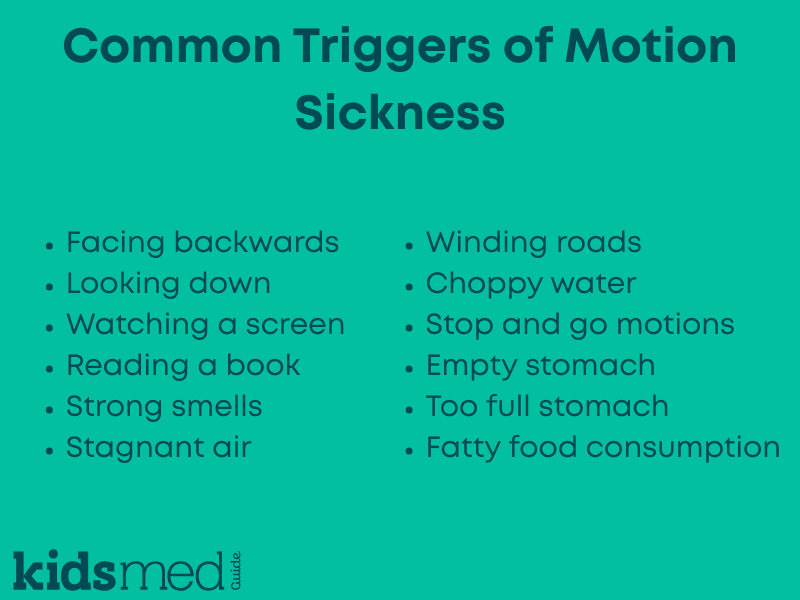
Several factors can exacerbate motion sickness during travel, including reading, screens, strong odors, heavy meals, and fatigue. Interestingly, traveling on an empty stomach can also exacerbate motion sickness.
Riding backwards, looking down, and a lack of fresh air also contribute to motion sickness. Aside from the usual modes of travel – car, train, boat, or plane – amusement park rides and similar experiences are triggers in their own right.
Safe Medication Options for Kids
Before giving any motion sickness medication to your child, consult their pediatrician first. I don’t love these older antihistamines for children because they have many side effects, interactions with other drugs, and shouldn’t be used in children under age six without professional guidance.
You should also consult your doctor or pharmacist if your child is taking other medications or has any health conditions.
Generally, non-drug options should be tried first, with medication reserved for infrequent, unavoidable situations like plane or boat trips.
The two main OTC options are dimenhydrinate and diphenhydramine. They are both antihistamines that block histamine receptors in the brain, central nervous system, and inner ear, helping to reduce nausea or vertigo. To be effective, a dose should be taken according to package instructions ½ hour to 1 hour before travel.
Dimenhydrinate (Dramamine for Kids)
Dimenhydrinate is commonly recommended for motion sickness in children aged 2 years and older. While the package says it is OK for age two and up, I would still consult with your pediatrician for those under age six or with other drug therapies or health conditions.
Diphenhydramine (Benadryl)
Diphenhydramine may sometimes be used for motion sickness, but it is not considered first-line. It isn’t given to children younger than six unless a pediatrician recommends it. The medication can cause drowsiness and sleepiness, or paradoxically, alertness and hyperactivity. Diphenhydramine should not be used to help children fall asleep.
Prescription options
Children with severe motion sickness should be evaluated by their pediatrician. If non-pharmacological measures and OTC medications are insufficient, prescription options may be considered in older children.
Options include promethazine (after age 6) and scopolamine patches (after age 17), but neither medication is routinely used in kids, and they are not first choices for motion sickness due to the side effect profiles in children. These should be discussed only for severe refractory cases and under the care of a medical professional.
Natural Remedies and Non-Medication Tips
Acupressure wrist bands (such as Sea-Bands®) may help some children with mild symptoms. Read the package label for age recommendations; these are generally safe for children because they are drug-free (ensure they are snug, but not too tight).
To help prevent or alleviate motion sickness in a child prone to getting nauseous, try the following:
- Avoid third row in a car or rear of bus/train seating if possible
- Ride facing forward on a boat or train
- Have your child look out and slightly forward, toward the horizon
- Allow for fresh air circulation
- Do not allow screens, reading, or anything that will have your child focusing in one spot
- Give your child a light, non-fatty meal an hour or so before travel
- Some children respond well to scents or tastes like peppermint or ginger. You might consider gum, mints, ginger tea, or anti-nausea candies (if they are age-appropriate and pose no choking risk); however, these are not proven remedies but anecdotal. If it helps your child and is safe for their age and developmental stage, that's excellent!
If you’re planning a long car trip, allow for frequent breaks and stick to the rules! For planes and trains where one cannot get off at will or open the windows for fresh air, use the other tips and talk to your pediatrician about medication use if the history of motion sickness is severe.
When to Talk to a Pediatrician
Reach out if vomiting is persistent or medications are ineffective. If your child gets severely ill or ill with every car trip despite best practices (looking out, fresh air, etc), they should get evaluated by a medical professional.
Conclusion
Motion sickness in kids is common, and it stinks! Trust me, I have cleaned toddler vomit out of my car more times than I care to remember. Use effective preventive measures and consult your pediatrician or pharmacist about using medication as needed in older children for longer, unavoidable trips.
FAQ Section
What age can children start taking motion sickness medicine?
Some medications such as dimenhydrinate may be used in children two and older, but dosing and safety vary. Always check with your child’s pediatrician before starting any medicine.
Are natural remedies safe for kids with motion sickness?
Many options like ginger, peppermint, acupuncture bands, and looking at the horizon are safe for most children. However, supplements should still be discussed with a healthcare provider.
How can I prevent motion sickness on long road trips?
Seat placement, light snacks, fresh air breaks, and minimizing screen time can help reduce symptoms. Preventive medication may be appropriate in some cases.
What should I do if my child vomits while traveling?
Offer sips of water, help them get fresh air, and clean up promptly. Consider stopping for a short break and reassessing whether medication or a different seating position is needed.
Can motion sickness get better as kids grow older?
Yes. Many children outgrow motion sickness as their sensory systems mature, though some may continue to experience symptoms into adolescence.
The following references were used to compile this information:
Car Sickness. (2007, June 1). HealthyChildren.Org. https://www.healthychildren.org/English/health-issues/conditions/head-neck-nervous-system/Pages/Car-Sickness.aspx?_gl=1*x37u11*_ga*NzQ5MjQyMzUuMTc2NTkzNzcyNA..*_ga_FD9D3XZVQQ*czE3NjU5Mzc3MjQkbzEkZzEkdDE3NjU5Mzc3MjckajU3JGwwJGgw
DailyMed—CVS DIPHENHYDRAMINE HYDROCHLORIDE- diphenhydramine hydrochloride tablet. (n.d.). Retrieved December 16, 2025, from https://dailymed.nlm.nih.gov/dailymed/drugInfo.cfm?setid=3dd5b783-5b64-24b5-e063-6394a90ab4ee
DailyMed—DIMENHYDRINATE tablet. (n.d.). Retrieved December 16, 2025, from https://dailymed.nlm.nih.gov/dailymed/drugInfo.cfm?setid=6dfc5cb4-af0c-56c9-e053-2a91aa0a5d56
DailyMed—DIPHENHYDRAMINE ORAL LIQUID- diphenhydramine hydrochloride liquid. (n.d.). Retrieved December 16, 2025, from https://dailymed.nlm.nih.gov/dailymed/drugInfo.cfm?setid=af5b9c99-03b8-4cf3-80d5-e484b36b6873
symptomviewer—HealthyChildren.org. (n.d.). Retrieved December 14, 2025, from https://www.healthychildren.org/English/tips-tools/Symptom-Checker/IFrame/Pages/symptomviewer.aspx?symptom=Motion+Sickness&_gl=1*icxmna*_ga*MTk2MzgxNTQxLjE3NjU3NTczNzI.*_ga_FD9D3XZVQQ*czE3NjU3NTczNzEkbzEkZzEkdDE3NjU3NTczNzMkajU4JGwwJGgw
tab, K. M. E. link opens in a new. (n.d.). Staying Healthy While You Travel. Retrieved December 16, 2025, from https://kidshealth.org/en/parents/family-travel.html