Holiday Food Safety for Children with Allergies or Special Diets
The holidays create extra challenges for children with food allergies or special diets. Ensuring holiday party food safety requires planning, careful cooking, proper food preparation practices, and clear communication with your kids, other caregivers, and any adults who may offer them food.
This quick guide outlines steps parents can take to ensure Thanksgiving and winter holiday food safety for children and to minimize the risk of accidental exposure.
Why Holiday Food Safety Matters for Children
The holiday season represents a deviation from routine. It’s a wonderful time of year to celebrate with families, but it also involves large meals, unfamiliar homemade dishes, and shared kitchens and potlucks.
These factors increase the risk of exposure to allergens or ingredients that do not meet a child’s dietary needs. Cross-contamination, hidden ingredients, and last-minute recipe changes are common during the holidays. It’s also easy for hosts and well-meaning families to forget a dietary restriction or not understand proper preparation practices.
When considering Thanksgiving and holiday food safety for children, the goal is to anticipate these risks before the food reaches the table and to help prepare your child (in an age-appropriate manner!) to know which foods are safe to eat and which should give pause.
Not allergy-related, but also important? Infectious disease safety!
The holidays are prime time for foodborne illnesses and the transmission of GI viruses like norovirus. Read our ultimate norovirus guide for survival tips!
Common Food Allergies To Watch Out For
Many traditional family holiday dishes contain common allergens. Family members or kids helping out who are unfamiliar with your child’s allergies might not think about these ingredients – after all, stuffing or salad doesn’t immediately suggest “tree nuts!”
Parents should recognize the higher-risk items usually present in holiday meals.
- Peanuts and tree nuts: salads, stuffing, desserts
- Dairy: mashed potatoes, casseroles, rolls, pies… unfortunately, lots of recipes call for butter or milk!
- Eggs: baked goods, breading, some casseroles
- Gluten: stuffing, rolls, gravy thickened with flour, pie crusts
- Soy: marinades, canned broths, processed foods
- Shellfish (less common but definitely possible): appetizers, family-specific dishes
Even small amounts of an allergen can trigger a reaction. Ask about ingredients ahead of time, and keep allergen-free dishes physically separated from others.
Safe Cooking and Preparation Tips
Preventing cross-contamination is an important and effective holiday allergy tip.
- Use separate cutting boards, utensils, counter space, and serving utensils for allergen-free foods.
- Prepare safe dishes first, before allergens enter the kitchen.
- Read every ingredient label, even on familiar packaged items, because formulations can change. Be aware of “processed in a facility that contains” or “may contain trace amounts of” – this can be a very important detail for children with severe allergies.
- Label allergen-free dishes so guests know which foods are safe, and also label dishes that contain common allergens.
- Keep children’s safe dishes in a separate section of the table to help avoid mix-ups.
These steps help maintain consistent food safety throughout preparation and serving.
Managing Special Diets During The Holidays
Not all dietary restrictions are due to allergies. Children may also be gluten-free, dairy-free, vegetarian, or follow other medical diets. Sensitivities to certain foods can make holidays uncomfortable if a child accidentally eats something they are sensitive to.
Parents can reduce stress by bringing at least one completely safe dish to gatherings, or perhaps a special dessert or snack to complement the meal. This ensures there is something your child can eat without relying on others to properly modify recipes.
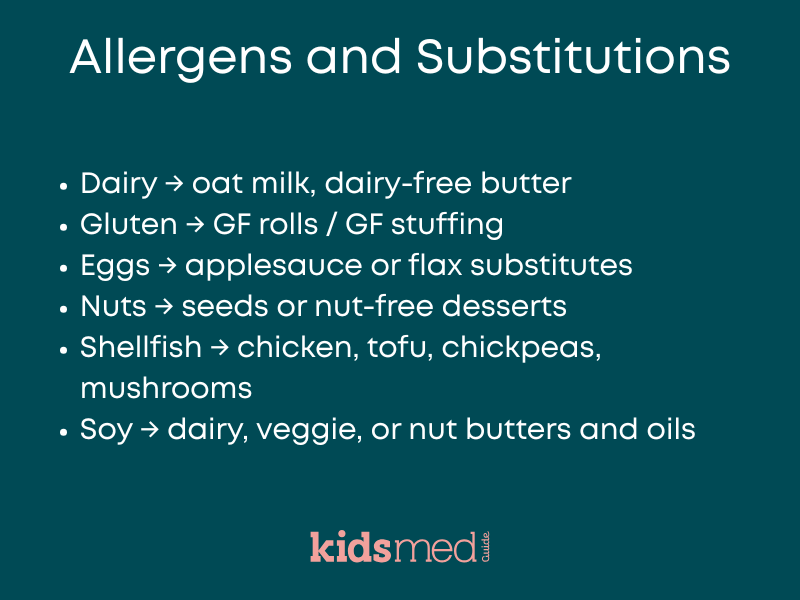
Many traditional dishes can be adapted with substitutions, like dairy-free mashed potatoes, gluten-free stuffing mixes, or allergy-friendly baking products.
Teaching Kids About Food Safety
Children should understand their dietary needs in age-appropriate ways. Encourage them to:
- Ask their parents or trusted caregivers about ingredients before trying new foods
- Stick to dishes identified as safe
- Politely practice saying “no thanks, I have allergies” when offered an unfamiliar food
- Tell an adult right away if something tastes “different” or if symptoms start
If your child has a prescribed epinephrine auto-injector (EpiPen), keep it accessible at all times. Anyone supervising or serving your child food should know where it is and how to use it.
When To Seek Medical Help
Know the symptoms of an allergic reaction so you can act quickly:
- Hives or itching
- Swelling of the lips, face, or tongue
- Vomiting, abdominal pain, or diarrhea
- Coughing, wheezing, or trouble breathing
- Signs of anaphylaxis
Use an epinephrine auto-injector immediately for any severe reaction or exposure to a known allergen. Always follow your pediatrician’s advice on managing accidental ingestion. Call emergency medical services right away for severe reactions. Inform family members or hosts in advance about symptoms to watch for.
Conclusion
Thanksgiving and winter holiday food safety for children requires extra planning. Coordinate with your family or meal host to identify which foods are safe and which are not, and consider packing a meal that your child can definitely eat! Teach them to ask before trying new foods and how to say “no thank you!” Always keep your EpiPen nearby and know what to do in case of an emergency.
FAQ
What are the most common food allergies in children?
The most common childhood allergens are peanuts, tree nuts, milk, eggs, wheat, soy, fish, and shellfish. These are widely recognized as the major allergens by the FDA, CDC, FARE, and AAP, and they frequently appear in holiday meals and baked goods.
How can I prevent cross-contamination when preparing holiday meals?
Cross-contamination can occur easily during large holiday gatherings. To reduce the risk:
- Prepare allergen-safe dishes first
- Use separate cutting boards, utensils, and cookware
- Clean surfaces well between tasks
- Avoid shared serving spoons
- Keep safe dishes in a physically separate area
What should I do if my child has an allergic reaction during a holiday meal?
Administer intramuscular epinephrine immediately if your child is experiencing symptoms of a severe allergic reaction or was exposed to a known allergen. Then call emergency medical services.
Are there allergy-friendly alternatives to traditional holiday dishes?
Yes. Many families choose gluten-free stuffing or rolls, dairy-free mashed potatoes, egg-free baking substitutions, nut-free desserts, or other modified recipes to accommodate allergies.
How can I talk to relatives about my child’s dietary needs?
Share a simple list of allergens your child must avoid, explain the importance of preventing cross-contamination, and let relatives know which dishes you will bring. Providing brief, specific instructions helps others support a safe meal environment.
Gobble till you wobble!
The following references were used to compile this information:
Don’t let hidden holiday allergies ruin your good cheer. (2024, September 10). ACAAI Patient. https://acaai.org/resource/dont-let-hidden-holiday-allergies-ruin-your-good-cheer/
Facts and Statistics—FoodAllergy.org. (n.d.). Retrieved November 24, 2025, from https://www.foodallergy.org/resources/facts-and-statistics
Food Allergies | Causes, Symptoms & Treatment | ACAAI Public Website. (n.d.). ACAAI Patient. Retrieved November 24, 2025, from https://acaai.org/allergies/allergic-conditions/food/
Food Allergies in Children: Causes, Symptoms, Diagnosis & Treatment. (2025, October 8). HealthyChildren.Org. https://www.healthychildren.org/English/healthy-living/nutrition/Pages/Food-Allergies-in-Children.aspx